Showing posts with label historical. Show all posts

Sunday, 19 January 2025

Plans

I'm hoping to get back behind (in front of?) my machine soon

Initially I wasn't going to make any creative plans for 2025. Both Christmas Day and my birthday earlier this month were completely taken up by having to deal with family issues, and this is only going to happen more frequently, and for longer, in the future. Indeed, part of the reason why I knit so much now is that it's far easier to take that with me when I have to be away from home than taking my sewing. So with all this in mind, there seemed no point in planning any projects.

But then it struck me that this was being a bit defeatist. Yes I may not get much done, but surely it is better to have some plans and accept that they may be derailed, than to not even try. So, with the understanding that these are very much aspirations, here we go.

Historical sewing
The success of my Victorian toile has definitely made me want to revive my 1874 ensemble project.

The ultimate aim

Realistically, there's no chance of me completing the whole thing in a year, but I would like to get the under layers done. I've decided that I do want to make a new corset using this Truly Victorian pattern, as the Laughing Moon one has too little waist definition. After that, the next things to make will be the bustle cage and petticoats. All of these can be done as challenges for the 2025 Historical Sew Monthly (along with a couple of other things, if I really get going), and I'm hoping that this will spur me on.

Stash
I say it every year, and every year I fail dismally - I really want to sew from my stash. The stash shop definitely helps in reminding me what I already have, but not going into fabric shops would be a bigger help. This wonderful Tom Gauld cartoon appeared in The Guardian last year, and I did give serious thought to building something similar for fabric storage!

Painfully relatable

I seem to be having a bit of a confidence crisis about getting things to fit properly, which is putting me off sewing at all, so I need to find a way to address this. Also, I have come to the conclusion that some of the fabric in the stash will never be used, either because my tastes have changed since I bought it, or I should never have bought it in the first place. So there will definitely be some stash reduction this year, as I rehome several lengths with people who will actually use it.

Part of the stash shop - two more used, and one rehoming candidate

Knitting
Having finished both my other projects, I have finally started my Poppy jumper.

The kit for Poppy

I went with my plan to knit the sleeves first, so that they are not waiting for me at the tail end of the project. With 2.75mm needles for the ribbing and 3mm needles for the rest, this is the finest gauge knitting that I have done so far, and it's going to take me a long time. I suspect that another project (with bigger needles) might get picked up for light relief. Even double knitting would feel chunky after this! Which brings me to

Waiting to ambush me

Squirrels
Whether I plan my year down to the last week, or take a more relaxed approach, I know that a squirrel project or two will always come along to disrupt things. Let's just see what 2025 brings, and be grateful for anything that I do get done.

Friday, 25 July 2014

Ottoman costume - progress of a sort

An early post this week, as I won't have the opportunity to post it on Sunday.

Not for the first time while making this costume, I found myself looking at something laid out on the table and thinking, "My, that's an 'interesting' shape". The latest candidate is the cotton lining for my entari/caftan, which is also doubling as a toile for the outer layer.

!!!?

Ottoman caftans are described as being 'bell-shaped', unlike Persian caftans, which have smoother lines. This example shows the shape particularly well. (Apologies that I don't have any more details for this image).

15th century Ottoman caftan

Even though I need some extra width to accommodate the gathered bulk of the excessively wide trousers, this is taking things a bit far. The illustration that comes with the pattern seems to suggest that some sort of pleating occurs, so I think I'll experiment with that.

Looks like pleats to me (she says, hopefully)

While I pondered what exactly to do with my big curvy side pieces, I thought I'd get on with the hat. I have an embroidered hat of Mr Tulip's which is exactly the right dimensions, so I worked from that.

Hat inspiration

As I no longer need all of the patterned fabric of the shalwar kameez suit set for a wide sash, I used some of it to make the hat. A pillbox hat should be perfectly simple to make; a strip of fabric sewn round a circle of fabric, right? I did just that, with some interfacing sewn in to stiffen it. Unfortunately when I tried the first attempt on, it looked as though the band narrowed from the top down. The effect was a brimless version of this hat, not at all the look I was after!

The Arnolfini Wedding by Jan van Eyck

When I looked at Mr Tulip's hat properly, it was obvious that there was a slight gather where the band meets the top. I did this to my hat, and it looked much better.

To trim the hat I dug out some red and gold braid which had been lurking in my stash for years. It was surprisingly heavy. When I inspected it, I discovered that the red and gold 'cords' which are unravelling in the botton left of the photograph are actually fine wire round tightly round a thick cotton core. Adding a bit of weight to the hat is no bad thing, as it is currently very light and flimsy.

Braid to trim the hat

The duppata which came with the shalwar kameez will be pinned onto the hat. The last time I tried using a dupatta as a veil for dancing, I discovered that although it looked very light, it actually had the floaty properties of sheet lead - reasonable really, as the whole point of a dupatta is that you don't want it to blow away! So, I can be reasonably sure that my headgear isn't going to go anywhere.

The gomlek (shift) is a very simple T-shaped tunic with underarm and side gussets. It should be slightly longer, but making it this length allowed me to get both the body and sleeve parts cut out with a selvedge at the hem. The construction is by machine, but all the seams are finished by hand, as I find that this gives a softer result. The neck opening is hand-finished as well. I hadn't sewn the buttons on when this photograph was taken.

Almost-completed gomlek

The medieval fair all this is being made for is a weekend event. I hate wearing the same shift two days running, so I've had to make two of them. That's a lot of hand-finishing.

So now back to the coat and its huge pleats.

Sunday, 20 July 2014

All change

(Or, why the costume I’m actually making is very different from the costume which I thought I was going to make.)

Back in May it all seemed so simple. I was going to make a new costume for the Medieval Fair I would be attending with Ya Raqs in the summer. I pretty much knew what I was going to make and shopped accordingly: big harem pants, a white cotton blouse with long sleeves split from the elbow, a lavishly trimmed coat which fitted under the bust and also had long split sleeves, and a wide sash.

I had these sort of images in mind, even though they date from a far later period. Somehow I blithely assumed that because it was 'traditional' dress it would have remained unchanged for centuries!

Ghaziya, c. 1839

Ghawazee dancers by Emile Prisse d’Avennes, 1848

Well unsurprisingly, that’s not quite how it’s turning out.

The first thing to go was the wide trim. This is made from a 5cm / 2” wide braid with alternating circular and flower motifs, woven in blue and red, and then heavily decorated with sequins, beads and sew-on stones. It’s pretty, and it prompted the colour scheme of the entire costume, but in the cold light of day, even with no research whatsoever I could tell that it’s not remotely appropriate. So into the stash it goes.

Modern (too modern) braid, back and front

Then I went online and did some research on Persian and Turkish costume for the period. It started promisingly when I found this. The sleeves and neckline were different, but I could live with that.

Turkish costume

However, even though the image was described as "15th century Turkish women’s costume", it was obviously not a contemporary 15th century image. So rather than just dive straight in, it was back to the research.

As I explained last Sunday, big puffy super-bloomers turned out to be a later element of Turkish costume. As it transpired, so were split sleeves, the neckline cut under the bust, and wide sashes. Instead the entari, the garment worn over the shirt, had a round  or 'V' neckline and usually short, wide sleeves with a curved edge for the bend in the arm. It was often fastened with frogging. The belt was long, but narrow.

This site, which was the source of my shalwar pattern, has lots of useful information information on Ottoman costume. Especially helpful for me are several images depicting dancers.


I love the fact that the bottom two dancers appear to be doing something cheeky/coy with their face veils, a move which is still used (with varying degrees of cheesiness) today!

Having decided on the basic design, it was on to fabric choices. The gomlek, the long shift or undershirt, came to below the knees and was always made of a very sheer fabric. I'm going to use a fine muslin.

The original plan for the outer layer was to use the same fabric as I used for the trousers, but in a different colour, and lined with a third colour. I soon realized that it's far too soft and drapey to hang properly, or to support the weight of the decoration, so I planned to interline it with cotton. However, the more research I did and the more I thought about it, it seemed silly to put so much work into something which would be so inherently wrong. Back to the fabric shop I went. I wanted to keep it plain, and found a linen/rayon mix in a suitable colour. Yes it should really be pure linen, but I will be sitting on floor cushions for two days, and a linen entari would look as though I'd slept in it after an hour or so. The lining fabric also ended up being replaced, with cotton. The very boring photo below shows the original coat and lining fabrics at the top, and their replacements below. Shame, because I really liked the colour of the original coat fabric. Still, I'm sure I'll find a use for it.

Well, I did say it was boring!

The frogging is going to be more ornate than is entirely appropriate, but there are some things which I can't quite give up! It started off with just the maroon and gold cords and the leaf motifs, but then I remembered that I had some dark red soutache which had migrated from my friend Kebi's mother-in-law's stash to mine, and it's a perfect match.

Frogging materials

Now all I need is for the Time Fairy to pop round with a few extra days!

Sunday, 9 March 2014

Glastonbury

Mr Tulip and I have been on holiday, to Glastonbury in Somerset. I was attending the wonderful Majma dance festival, which takes place there every year (this was my 12th festival!), and we stayed on for a few days after that.

The area has been inhabited since Neolithic times, and has a rich and varied history: some of it rooted in fact, some of it rather less so. There's a lot to tell, so this is quite a long post.

Easily the most prominent feature of the area is Glastonbury Tor ('tor' is an old English word referring to a high rock or a hill). At a height of 158m / 518' above sea level, it is clearly visible for miles around.

Glastonbury Tor, picture from Wikipedia Commons

The Tor consists of hard sandstone, which was left exposed when the softer ground around it was eroded. It is topped by St Michael's Tower, which is all which now remains of the 14th century church of St Michael. This church became a daughter chapel of Glastonbury Abbey, and like the abbey was demolished as part of Dissolution of the Monastries in 1539.

St Michael's Tower

The sides of the Tor are formed into seven deep terraces, and there is no definitive explanation of how these were formed. Suggestions include defensive ramparts to protect an Iron Age fort at the summit, man-made terracing in the Middle Ages to make the land easier to cultivate, a medieval 'spiral walkway' created for pilgrims to reach the church on the summit, or the remains of a three-dimensional labyrinth.

An image of the Tor, © The National Trust

These last two possibilities sum up the essence of Glastonbury. It has been a centre for Christian worship and pilgrimage for over 1300 years, but has also been associated with the 'Isle of Avalon' of Arthurian legend (a theory endorsed by the monks of the medieval abbey), Celtic mythology, and a number of other mythological and spiritual chronicles.

Below the Tor, in the centre of the town, are the remains of Glastonbury Abbey. The first stone church was built here in the 7th century, and was greatly enlarged before being destroyed by fire in the 12th century. The Abbey was rebuilt, starting with the Lady Chapel, which was constructed on the site of the very first church.

Interior of the Lady Chapel c1900, picture from Wikipedia Commons

The Lady Chapel today

North door of the Lady Chapel

During the rebuilding, the tombs of King Arthur and Queen Guinevere were allegedly discovered in the cemetery, and the bodies were reburied with great ceremony in front of the High Altar of the new abbey. Unsurprisingly, later historians have expressed scepticism about this story. Medieval monasteries were not above what we would today call 'marketing ploys' to encourage pilgrims to visit, and King Arthur's tomb would certainly be a draw!

The abbey ruins, looking west. King Arthur's tomb is marked by the black posts and chains in the centre

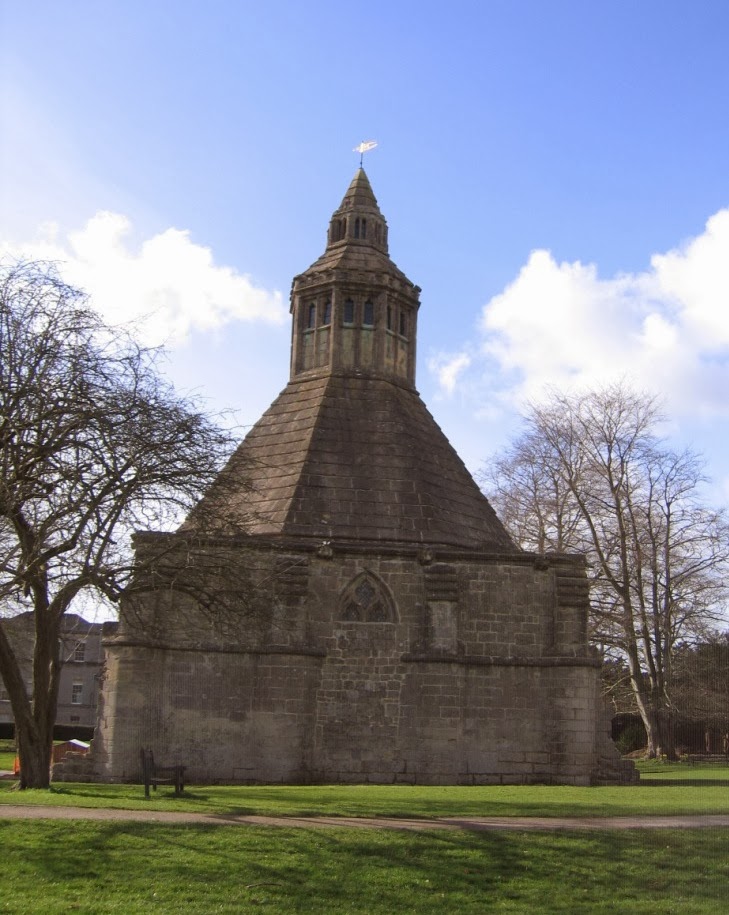
By the time of the Dissolution, Glastonbury was the second richest religious foundation in the land, second only to Westminster Abbey in London. The only building on the abbey site to remain virtually intact, the Abbot's kitchen, demonstrates just how wealthy and magnificent the abbey had become. The kitchen existed purely to prepare food for the Abbot's table, not for the rest of the monks. As it has four huge fireplaces, one in each corner, it's safe to assume that the Abbot dined well.

The Abbot's kitchen

If the kitchen shows the most privileged end of abbey life, St Patrick's Chapel shows the simplest. Built in 1512 and originally an almshouse chapel, it has recently been restored to show how a medieval chapel might have looked, with colourful wall paintings, some of the Abbey's original stained glass, and a simple altar.

East wall of St Patrick's Chapel

The abbey ruins, along with the surrounding parkland, are open to the public. The Visitor Centre contains displays about the history of the Abbey and religious life, plus a scale model of the Abbey as it would have looked before the Dissolution.

The Abbey entrance

Model of the abbey, including the gatehouse (bottom), the almshouses and St Patrick's chapel (beyond the gatehouse), the Lady Chapel (immediately in front of the two towers of the main abbey building) and the Abbot's kitchen (right)

Further evidence of the abbey's wealth can be found nearby, at the magnificent Abbey Barn. This was built in the 14th century to store the grain which the abbey received in tithes from its tenant farmers. The barn now forms part of the Somerset Rural Life Museum. This museum is largely responsible for my involvement in the Historical Sew Fortnightly, as it was here that I bought the pattern for my Glastonbury Bonnet last year.

The Abbey Barn

Barn interior

Outside both St Patrick's chapel and the Abbey Barn are Glastonbury Thorns. Often called 'The Holy Thorn', it is a type of thorn found in the Middle East, and is unusual in that it flowers twice a year; at Christmas and Easter.

Glastonbury Thorn outside St Patrick's Chapel

Legend has it that the first Thorn Tree was the staff of Joseph of Arimathea, and that when he travelled to Britain in the first century AD he came to the Isle of Avalon by boat, climbed Wearyall Hill and thrust his staff into the ground, where it took root and flowered. Sadly the Glastonbury Thorn on Wearyall Hill was cut down by vandals with a chainsaw in 2010, and a sapling grown from its remains and planted in 2012 was also destroyed last year.

The original Wearyall Hill Glastonbury Thorn, picture from Wikipedia Commons

By the way, the name "Wearyall" is from the Norse word for whale, and refers to the shape of the hill. The Wirral peninsular, near my home in Chester, takes its name from the same root.

Wearyall Hill seen from the Tor

Glastonbury became an important centre of pilgrimage (clearly the King Arthur story worked!), and pilgrims need somewhere to stay. In the 11th century a 'hospital' (then a place providing hospitality, not a place for people who are sick) for visiting pilgrims was built, with a chapel attached, not far from the entrance to the abbey. After the Dissolution there were of course no more pilgrims, and in the 16th century the single hall hospital was converted into two rows of almshouses. Stone from the now partially-demolished abbey was used for the alterations. One row of the almshouses was demolished in the 1960s, and now forms the garden of St Margaret's Chapel and Almshouses.

Chapel and almshouses, with the demolished row on the right

For pilgrims and other visitors looking for a little more comfort than a shared hall, the George and Pilgrims Inn was built on the High Street in the late 15th century, and is still a hotel today.

The George and Pilgims Inn

Further up the High Street are the Glastonbury Tribunal, a 15th century merchant's town house which now houses the museum and tourist information centre, and the church of St John's, also from the 15th century.

St John's

Glastonbury Tribunal

Between the Tor and the town lie Chalice Well Gardens. The Chalice Well is situated over a natural spring, and was the original water supply for the Abbey and the town. The water flows at the amazing rate of 25,000 gallons / 110,000 litres / 30,000 US gallons per day, at a constant temperature of 52 degrees centigrade. It has never failed, even during droughts.

The Chalice Well. The cover was made in 1919.

The name comes from the legend that Joseph of Arimathea hid the Chalice of the Last Supper beneath the waters of the spring, after which they flowed red. A more prosaic explanation is that the high levels of iron in the water are what gives it a reddish tinge! Like the hot springs in Bath, 21 miles away, the water is thought to have healing properties.

Red staining from the water

Glastonbury today has a strong 'New Age' feel to it; there are a lot (and I mean a lot) of alternative shops dotted around, with names like 'Enchantment' and 'The Psychic Piglet' (yes, honestly). But if you sit quietly for a while, on the Tor, in the abbey grounds, or in the Chalice Well Gardens, there is a sense of a place which has had its roots in faith, of whatever type, for a very long time.

Sunday, 9 June 2013

Macclesfield silk

Less than 40 miles from my home is Macclesfield; a town which has been involved in the silk trade for over 350 years, and which was once the world's biggest producer of finished silk. Given my interest in all things fabric-related, you might think that I would know all about the place; but in fact yesterday was the first time I have visited it properly.

The trip was prompted by the Adamley silk sale. Adamley is one of the few remaining silk firms in the town, and specialises in silk printing. Twice a year it holds a one-day sale of roll ends and printed seconds. Mr Tulip came with me, to fulfil what is clearly the role of all husbands at the sale: patiently holding onto the items already selected while their partners search for yet more goodies!

Adamley silks on sale at the Heritage Centre

Purchases packed in the car boot; we set off to visit the town's museums. As the sale was held in the first of these, we didn’t have far to go.

Macclesfield Heritage Centre, the words "Sunday School" just visible at the top of the building

The Heritage Centre is based in the old Sunday School, where the children working in the silk industry received a basic education on their one day a week off work. The museum tells the story of the silk industry in the town, starting with the button trade.

By the mid 17th century button making was an established cottage industry in Macclesfield. The buttons were made by women and children, working at home. Firstly layers of floss were wrapped around a wooden mould, and then this was decorated by wrapping it with silk and mohair yarns. Chapmen provided the materials, and collected the finished buttons, which were then sold as far afield as London.

1750s sample card of Macclesfield buttons

The trade links to London provided the next stage of Macclesfield's involvement in the silk industry; yarn preparation by the process of 'throwing'. Originally done by hand, the town's first water-powered throwing mill was built in 1744. Raw silk was brought from London for throwing, and the yarn returned to London to be used by weavers in Spitalfields.

Mantua of Spitalfields silk, V&A

As fashion turned from the elaborate figured Spitalfields silks to plainer designs, silk weaving began in Macclesfield. Initially this was done by weavers in their own homes, known as garrets. These had a workshop on the top story, above the living quarters.

1960s photograph of weavers' garrets

In the early 19th century weaving began to move to the factory system, a change which was exacerbated by the development of the more costly jacquard and power looms. Even if a weaver was not directly employed by a mill, he would have to pay to rent a loom.

The silk industry was subject to regular fluctuations in trade, with many of the downturns occurring when Britain was not at war with France. French silks were considered to be superior in terms of both quality and design; so whenever they were more readily available, the British silk industry suffered.

By the 1830s there was a view that more needed to be done nationally to improve British design, and a number of design schools were set up. In Macclesfield this began with the wonderfully-named Useful Knowledge Society, which held drawing classes. In 1852 the Macclesfield School of Art was established, with its own premises. The Art School is now the home of the Silk Museum.

Macclesfield School of Art

By the 1880s it was recognised the technical as well as design skills were needed for the silk industry to be successful, and the Silk Museum contains many examples of the course work completed by students of the Art School and the later Technical School. For example, it was not enough for a woven fabric to have an attractive design; the warp and weft threads must cross frequently enough for the cloth to retain its strength.

Exhibition sample by Cyrus Fytton

Laboratory book and woven sample

The examples of students' weaving were especially interesting to me, as I own part of a sample piece of Macclesfield silk. It is 3.5m long and woven with a black warp and different coloured wefts, in sections approximately 9cm long.

My sample of Macclesfield silk

The Silk Museum also has a section on the development of synthetic fabrics. As well as the weaving and printing of various rayon and nylon fabrics, Macclesfield was the birthplace of crimpelene - but I'm trying not to hold that against the town!

Printed nylon and (shudder!) crimpelene

Macclesfield did not just manufacture fabric; a number of firms were established in the town to make machinery for the mills.

1920s(?) advertisement for a machinery manufacturer

The Machine Gallery contains a number of these machines, including the massive silk picture loom.

The silk picture loom

One of the woven silk pictures

Near to the Silk Museum is Paradise Mill, the third of the Macclesfield silk museums, containing 26 restored Jacquard looms. Sadly the mill can only be visited as part of a guided tour, and all of the places for the day were already booked up by a large party.

There is a lot more to see in the museums, I've only written about parts of them. They are certainly well worth a visit.

Finally, when looking for images of Spitalfields silk to use in this post, I came across a recent photograph of  weavers' houses in Macclesfield. To my surprise it came from the blog of a friend of Mr Tulip's, the writer Clare Dudman. You can read her post about the decline of Spitalfields here.