Showing posts with label Maud. Show all posts

Sunday, 18 September 2022

Mystery project

As in, it's a mystery to me, too! Usually when I make something, either I'm using a pattern or I've worked out all the details before I start - sketches, dimensions, notes etc. This time, it's very much making it up as I go along.

I've wanted to make a 1930s-themed clutch bag to use with my dress version of Vogue 2859 for some time. To me, few things sum up that decade like the sunburst design.

Pye radio, 1931 (image © Victorian and Albert Museum, London)

Browsing through images of 1930s bags online I came across this, and thought that the shape would work well with the sunburst motif. I experimented with variations on size and proportions until I came up with a pleasing shape which could hold everything I need to put in an evening bag.

1930s clutch bag, image found on Google

For once, I knew that I had the perfect fabrics in my stash. Years ago I bought a fat quarter of a quilting cotton with an orange branch print, for no reason other than I liked the design. I’d also bought a plain orange fat quarter to go with it. It’s not a 1930s print, but the colours are ideal for this project, and go well with the dress. Also in the stash I found a length of plain teal cotton (no idea where it came from!) which works wonderfully for the lining.

I drew the design onto a stashed piece of cream cotton, and thread-basted over the lines. Then I basted this onto a piece of the print fabric.

The bag outline and rays thread-basted in reverse

The rays were cut out from the plain orange with generous seam allowances, machined onto the print along one edge, then flipped into place and pressed. The excess fabric was trimmed off the seam.

Sewing on the rays

Then the other edge was folder under and pressed, and the excess trimmed off. This edge was hand sewn.

The rays completed

The back of the bag will just consist of the print fabric backed with the cream. However to hold the layers together, and to echo the design on the front, I machined them together using a mirror image of the sunray design.

The inside of the back, showing the complete design

It's barely visible on the right side, but holds everything together

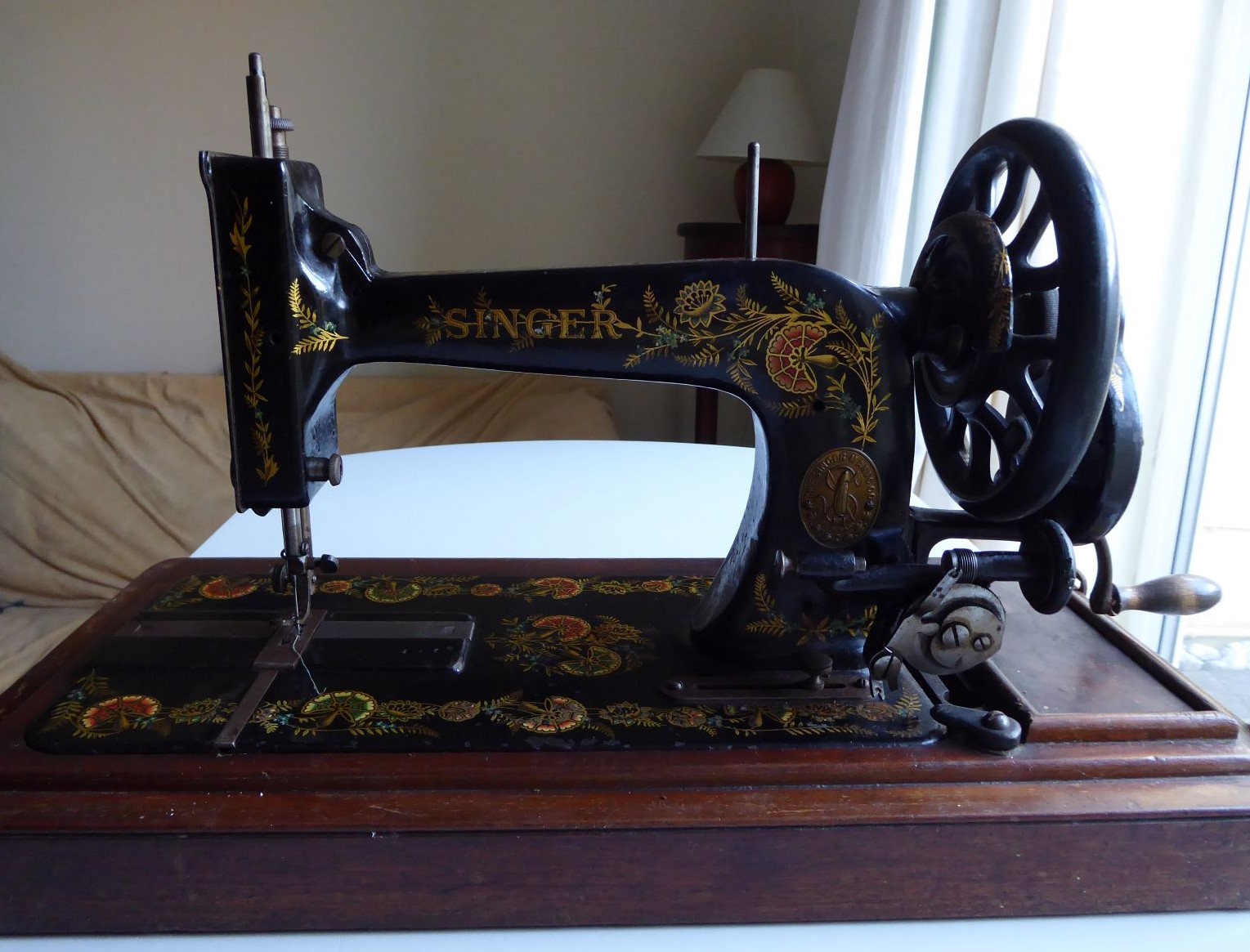
Sewing the sunrays required more precision than I can manage on the treadle machine, so instead I used Maud, my 1917 hand-crank. Yesterday was a lovely sunny day, and as we will soon reach the time of year where the sun isn't high enough to come over the neighbouring house, I took advantage of my 'portable' machine (I use the word loosely!) to work where I could enjoy the direct sunlight.

Sewing in the sun

Once the outer parts were done, it was on to the lining. It consists of two layers of the teal cotton: one full size and one smaller, to create pockets.

The completed lining

As is obvious from the lining shape, the bag in going to have a flat base, and side panels. It is also going to have a zip along the top. I have several books which include instructions for making bags, but all of them are flat 'envelope' styes with just a front and a back. They also all have front flaps, which wouldn't really work with the sunray design I wanted. Hence the 'mystery project' title - I have most of the individual elements, but I now need to consider how I'm going to put them together. Gulp.

Sunday, 1 May 2022

Maud restored

I've not had a lot of time for sewing this week, but I am very pleased and proud to have completed the work on my 1917 hand crank machine, so brace yourself for more restoration spam!

I can claim no credit for fixing the tension. Helen Howes provided me with a complete, new-to-me tension unit (the original was even more broken than I'd realised), and all I had to do was swap them over.

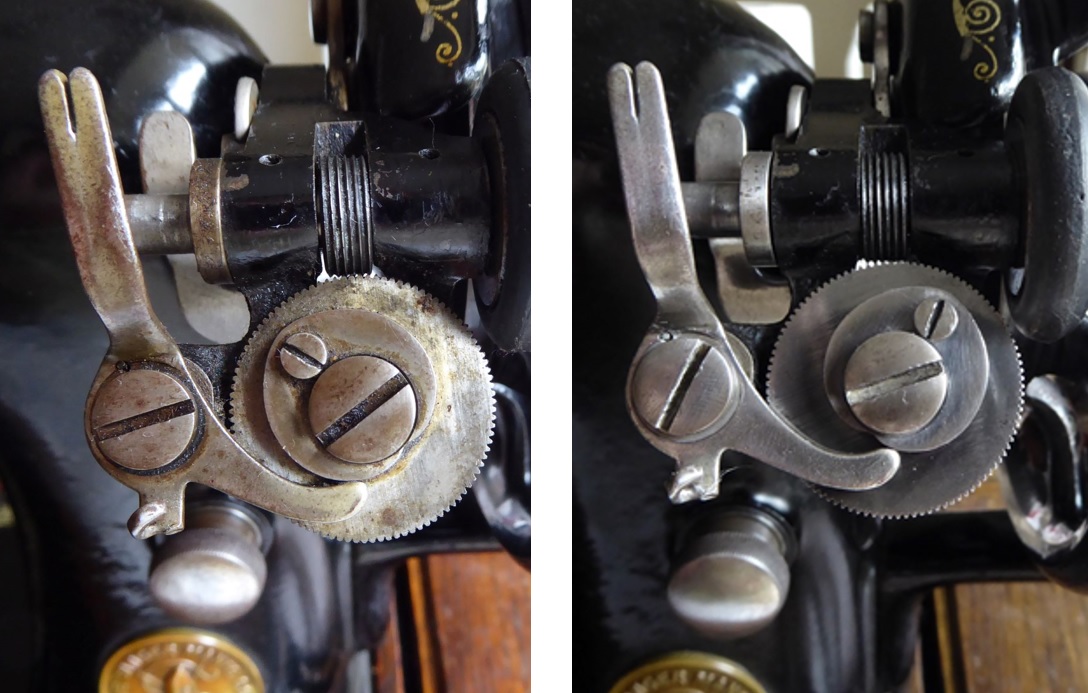
The bobbin winder was another matter, though. It worked but, oh my, it was grubby. I followed this video for taking it apart for cleaning. From my experience the crucial things are: 1) you cannot take too many 'before' photos to work from when reassembling it; 2) take it very slowly and carefully, so no pieces which are held in tension spring out and get lost; 3) label everything. I can't stress this last one enough.

The bobbin winder's 18 separate parts

To my great joy and relief, when I came to put it all together again there were no missing pieces and no pieces left over. Along the way I learned about all sorts of new things such as worm wheels and eccentric screws.

Eccentric screw - the thread is offset from the centre

Before and after cleaning

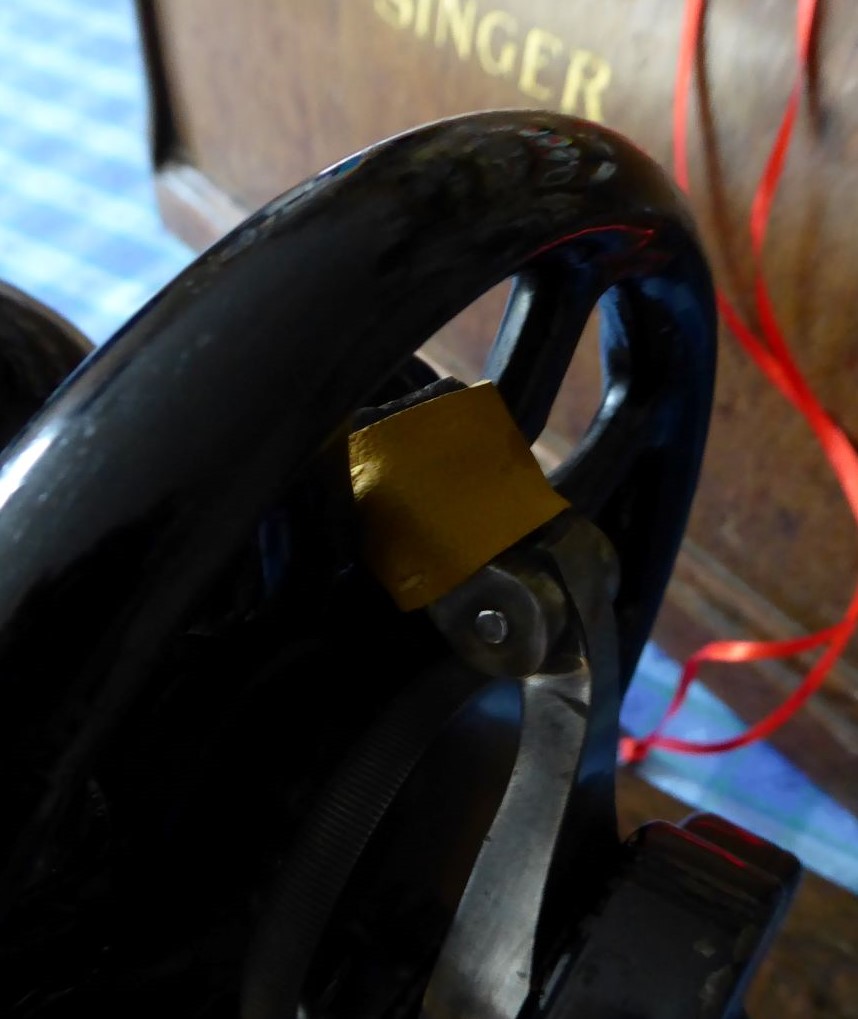
Next. Remember the stopper on the hand crank mechanism?

This one

The one which I thought was made entirely out of very old sticky tape?

I was wrong. It was worse than that.

It was actually made of old sticky tape and old sticking plaster. Such old sticking plaster that it disintegrated as soon as I touched it. Urgh. It has now been replaced with a leather version, following Helen's instructions.

The new, and definitely improved, version

Finally, I made a new spool felt. Modern sheet felt is far thinner than the Singer version, but fortunately I've kept all my hatmaking hood offcuts, and the leftovers from my lampshade hat were the perfect red.

So here is the end result. I have seen far more ambitious and compete restoration projects than this, but I'm very happy with mine. Maud will never look as though she has just rolled off the production line at Kilbowie (and sometime I will write a full post about Singer's Scottish factory), but I wouldn't want her to. She’s a 105-year-old working machine, and I prefer her appearance to reflect that.

All done

I've learned so much from this project, and gained a lot of confidence about what new things I can actually do if I try. And most importantly, Maud now sews like a dream. Here’s to another 105 years!

Sunday, 17 April 2022

Spring has sprung

Q. What is wrong with this picture?

I do apologise. That is probably the worst pun ever to appear on this blog in 10 years of writing. But I just couldn't resist.

Unusually for me, I'm not really in the mood for sewing right now. I've come to the conclusion that Butterick 6866 doesn't really do me any favours (it may be the colour), and this combined with The Great Embroidery Disaster, has left me at a bit of a loose end.

Readers with long memories may recall my plans last autumn to restore a 1903 Singer 48K sewing machine. Unfortunately, this got put on hold for a bizarre reason. There is a strong smell whenever I take the case off, and it's not of sewing machine oil - it's more like heavy engineering oil! Whatever inappropriate substance was generously applied, for me it's a migraine waiting to happen. So the 48K, now christened Deltic Elsie in honour of her pungent whiff, will have to wait until I can work on her outdoors.

Be grateful that it's not possible to attach smells to blog posts!

In the meantime, I have been reading up online about restoring old sewing machines, and remembered that the tension on Maud, my original vintage machine, wasn't great. So, as a new sewing project wasn't on the agenda, I fetched her out to have a look.

Maud, a 99K hand crank from 1917

The tension on Maud . . .

Sure enough, at first glance she appeared to be missing a tension disc and the check spring. For comparison, here is the tension on Tilda.

. . . and on Tilda

When I unscrewed the tension nut, I discovered that there was a spring in there after all. Or at least, part of one. The hook end is broken off, and the whole thing is a mess.

Eep!

While looking online for a replacement spring and information on how to remove the original one, I discovered that 1. the spindle on which all the parts rest has a slight crack and 2. while most Singer 99s might look the same, this doesn't mean that they are. I can't comment on other areas, but I now know that the tension mechanism underwent lots of changes in the decades that the 99 was being produced. Some were readily apparent; for example Maud does actually have two tension discs, they are just different sizes from different eras! Others were more subtle - as I found when I bought what looked like a replacement spindle only a couple of years newer.

Yes, I do keep a vernier scale in my workbox - doesn't everyone?!

There was also the discovery of just how grubby the machine is. I had given it what I thought was a reasonable clean when I bought it, but hadn't tried to dismantle anything. Armed with more knowledge, and a lot of YouTube videos, I'm now taking things apart to do a more thorough job.

The bobbin winder in particular needs work

A lot of work

At some point the stopper on the end of the hank crank needs to be replaced, too! A big thank you to Kate for recommending Helen Howes - thanks to her considerable knowledge this, and everything else, is now in hand.

Genuine 1917 sellotape. Or not

But most importantly, I find I'm enjoying all of this. It's fascinating to look properly at something I've used, pretty much unthinkingly, for about 50 years, and get a better idea of how it all works. I'm also amazed that I managed to make a dress and a top on a machine with a barely-functional tension - testament to what workhorses the old Singers were. Anyone who has read this blog for a while will know my views on the throwaway society, and being able to restore a 105-year-old machine fits right in with them.

There is a lot of information about 99s and 66s out there, and lots of parts available. This is hardly surprising; according to the ISMACS database, over 13 million were made worldwide. By contrast, there were only half a million 48Ks made (it may even have been fewer, those were the production numbers allocated). So, I think that cutting my restoration teeth on an 'easy' model before attempting something relatively obscure has turned out to be a wise move - for once, my squirrel tendencies have been useful!

Sunday, 11 March 2018

New sewing machine!

Well, new to me.

I’m just back from my annual trip to Somerset. Sadly the atrocious weather last weekend meant that I only managed to get down there in time to see the final show of the Majma dance festival, but I’ve still had a fun week, and made an exciting purchase.

Driving from the M5 to Glastonbury I passed several signs for an antiques fair at Shepton Mallet, taking place this weekend. Vintage Gal has posted about some of her fabulous finds at these fairs, so I was thrilled to discover that I could actually go to one.

There were only a few textile-related stalls, but I did still manage to find a couple of 1970s Style patterns, some vintage metal lace and two lots of hat veiling, and some lovely sparkly buttons.

Not exactly a wasted trip, then!

And then just as I was about to leave, on one of the outdoor stalls, looking a bit sorry for itself and getting damp in the rain, I found this.

Ooh!

It was the case which caught my attention; I saw vintage film footage of these being moulded at last year's Plywood exhibition at the V&A. When I opened the case I found that the machine already had both a needle and a bobbin in place, so to the bemusement of the seller I threaded it up with a spare bobbin, and tried sewing round the edge of my handkerchief! It worked, I’ve wanted a hand-cranked machine for a while, and it clearly needed someone to rescue it from damp and neglect. . .

More ooh!

It’s quite worn in places and is clearly older than my mum’s 1953 Singer: it is plainer, and the section for the bobbins etc. has a wooden lid instead of a metal one. I guessed at 1930s because not many were made in the 1940s - the Clydebank Singer factory mostly went over to war work. Armed with the serial number, I went online to investigate, and found this helpful site.

The all-important (and wonkily stamped) serial number

I was, quite simply, stunned. My 'new' machine was made in 1917! No wonder it looks a bit worse for wear. And it’s still in working order (although to be fair there’s not a lot to go wrong). Clearly Singer had never heard of the concept of built-in obsolescence.

Essentially it’s the same model as the 1953 version; which is useful as this one doesn’t have an instruction booklet.

Mum's (now my) machine in its case

There does seem to be a wealth of information about 99K Singers online though, so I can give it a thorough clean and tidy up. And then, of course, I want to make something with it.

Although the 99K was designed to be 'portable', this really just means 'not attached to a treadle mechanism'. One thing it is not, is light. Casually swinging the case while strolling along, à la Kate Winslet in The Dressmaker, is not going to happen!

Erm, no (image © Universal)

While writing this post I realised that I now own four sewing machines. Some people might regard this as excessive. I am not one of these people. I am just unreasonably excited!