Sunday, 6 December 2015

New Look 6299

Not for the first time, my inspiration for making a dress has been a pair of shoes - although I like to think that this one is a fair bit classier than the previous attempt!

I'd seen some shoes I really liked, which came in black (which was what I wanted) or dark red. Unfortunately by the time I got round to buying them, the black was sold out. I only have one dress which would go with the red, made from New Look 6070, so the obvious solution was to buy a red pair anyway, and make another dress to go with them. You know it makes sense!

Off to the fabric shop I went, and found this in the craft cottons remnants bin. It's by Windham Fabrics, from their 'First Ladies' collection, circa 1865-75. A slightly odd choice for a modern dress perhaps, but I liked it, and it went perfectly with the shoes.

Windham Fabrics 'Wheat', in red

There were two separate pieces, so I bought them both, and then went though my pattern stash to find something which would make the best use of the fabric. New Look 6299, view D lengthened and all in one fabric, pretty much fitted the bill. I wasn't convinced about the sleeve length however, and New Look sleeves are always a bit short on me, so I extended them to bracelet length.

Pattern envelope, view D is the bottom right

I wasn't sure which neckline I wanted, so made the dress up as if for the collar, and put it on Nancy.

Alright, but underwhelming

It definitely needed the 'pop' of a contrast collar. Now, several reviews of the pattern I'd read online mentioned the collar, mostly unkindly. It is indeed a strange shape.

Collar pattern piece

The pieces are sewn together in a way which creates a tab, which is then fastened with a button.

Instructions for making up the collar

I had some thin black satin leftover from a previous project, and used that to make the collar. Once made up, I decided that I didn't like the tab at all, so got rid of it. Not one of my better ideas, as it turned out.

Meanwhile, I decided to try something different with the lining. I made up the basic dress, minus sleeves, in lining fabric, leaving the centre back seam open for the length of the zip. Next I sewed on the facing, and cut away the excess lining fabric beneath it.

Lining and facing, ready to go

Then I sewed dress, collar and facing/lining together, as per the instructions, and slip-stitched the lining to the zip tape. This proved much easier than making up the dress as normal and then trying to wrangle in a lining.

Some you win, some you lose. This was when I discovered that the collar really did need that tab fasten after all. Without it, the dress has a very odd neckline; too wide for a normal neckline, but not wide enough to be a feature. The back meanwhile just looks a mess.

Weird, wide neckline - front

Weird, wide and messy neckline - back

So, I ended up making a separate tab from a scrap of satin, and attaching it to the collar so that it could fasten properly. If only I'd left well alone in the first place!

Collar fastened properly, and looking much better

I didn't want any sort of cuff on the sleeves, so just finished them with a wide binding of black satin, to tie in with the collar.

I'm really pleased with the end result, and think that it will become a winter wardrobe staple. With the shoes, of course! Sadly the weather has been far too dismal for the usual back yard shot, so here's the end result on Nancy.

New Look 6299 completed

Sunday, 29 November 2015

Re-Do / Out of Your Comfort Zone

December is the Re-Do challenge in the Historical Sew Monthly; the time to re-do any of the previous 11 challenges. I'm using it as an opportunity to do the two challenges I've missed: Brown and Out of Your Comfort Zone.

Out of Your Comfort Zone was June's challenge, and defined as,
"Create a garment from a time period you haven’t done before, or that uses a new skill or technique that you’ve never tried before."

I had a plan for this challenge, but unfortunately it was so far out of my comfort zone that I never even mustered the courage to start! So it languished, with the vague idea that I'd tackle it in December. In the meantime, my friend Suzanne Iuppa asked me to make a medieval-inspired stage costume for her performances at Sanctum, a 24-day arts event taking place in the remains of a 12th-century Knights Templar church in Bristol.

The temporary Sanctum building. Photograph by Max McClure, taken from the Guardian website

Medieval is definitely out of my comfort zone (as is making clothes for other people!) as I've never made anything like that before. Suzanne wanted a dress and jacket/doublet, and had taken her inspiration from two films about Joan of Arc.

The Passion of Joan of Arc, Carl Dreyer, 1928

The Trial of Joan of Arc, Robert Bresson, 1962

All the readily available commercial patterns for 'medieval' dresses involved princess line bodices and waist seams. I may not have known much about medieval costume when I started this project, but I did know that it doesn't involve either of those things, so I decided to draft my own pattern. Fortunately I had Margaret Scott's Medieval Dress and Fashion for inspiration, and for practical advice Sarah Thursfield's The Medieval’s Tailor’s Assistant, plus The Dreamstress' tutorial on draping a fourteenth century dress.

Unfortunately what I didn't have was Suzanne to drape the dress on, so I had to improvise. I drafted a basic bodice block from Suzanne's measurements, and then manipulated the darts to create a block with a curved centre front seam. I made the sleeves longer and narrower, but stupidly didn't think to redraft them to move the seam from underarm to a more period-accurate centre back - gah!

This didn't really matter, because the end result was never going to be remotely historically accurate; its requirements as a stage costume for a solo performer in a cold environment (most of Suzanne's performances were taking place at dawn) had to take precedence. Thus the dress has a zip fasten, and both it and the jacket are made from fleece.

The mock-up of the dress was made in an alarming bright yellow, because this was half price in the fabric shop. After I'd reassured Suzanne that the finished article would not be this colour, she put the dress on inside out, and I pinned out the excess fabric, and marked the neckline.

Altering the back seam

The sleeve, with the new seam pinned out

The doublet pattern was drafted from the dress, with extra ease added. Probably a bit too much ease, but it added to the impression that this was a man's garment. (Well, that's my excuse.) We decided to reinforce this idea by setting the buttons and buttonholes on the male sides, rather than the female. I added the small collar and the rolls on the sleeve heads, in line with the costume from the 1928 film.

Bad photograph (sorry) of the completed doublet

Suzanne wearing the doublet and dress at Sanctum

The doublet open, showing the dress

I added a lining to the jacket, as I feared that a fleece jacket and a fleece dress might stick together otherwise. Most of the lining was sewn by hand, as a group of us went down to Somerset for a long weekend shortly before Suzanne's performance. It's been a while since I've had the pleasure of spending a evening chatting with friends, drinking wine and sewing - it was lovely! One day we went to Wells, and Suzanne took the dress with her, in the hope of a photo opportunity. We managed to take some pictures in the cathedral, on the way up to the Chapter House. This is my favourite part of the building; I love the way one set of steps curves out from the main staircase. If it looks familiar, it may be because a couple of scenes in Wolf Hall were filmed here.

Wells Cathedral, the Chapter House steps

Suzanne on the steps

Looking down the staircase

The small print:
The Challenge: Out of Your Comfort Zone
Fabric: Fleece and lining fabric
Pattern: My own
Year: 1928 and 1962 do 1431
Notions: Buttons for doublet, zip for dress
How historically accurate is it? Far and away the least historically accurate item I’ve ever made in three years of the Historical Sew Fortnightly/Monthly, about 5%
Hours to complete: As ever, forgot to count
First worn: 5 November at Sanctum, Temple Church, Bristol
Total cost: £39.50

Sunday, 22 November 2015

Putting on the Glitz


Putting on the Glitz is the new exhibition at the Lady Lever Art Gallery in Port Sunlight on Merseyside, featuring twenty 1930s outfits from National Museums Liverpool’s fashion collection.

The emphasis is firmly on glamour; the exhibition begins with a silk crepe and lurex evening dress paired with a crepe-de-chine and marabou feather mantle, and a stunning bias-cut purple silk satin evening dress with cascades of ruffles down the back.

Silk satin dress 1932-35, crepe and lurex dress 1934-34, mantle about 1930

There are dresses by well-known designers, and others which were bought or made locally.

Left to right, dresses by Mainbocher, Lachasse, a local dressmaker, and unknown

For many people in the 1930s such clothes would only be part of the escapism offered by the movies, with little connection to their everyday lives.

Display board giving some context

This evening coat is part of the Tinne Collection, and was bought from George Henry Lee (a local firm, now part of John Lewis) in about 1930-36.

Silk velvet and angora rabbit fur coat

Not all of the dresses on display are evening wear. This wedding dress was bought from Brown’s of Chester (another local firm, still in existence) in 1930.

Wedding dress of silk satin with pearls and diamanté beads

Mirrors make it possible to see the back of some of the dresses - always a winner for me!

1936 evening dress by Callot Soeurs, and rayon jersey dress 1938-40

Close-up of Callot Soeurs dress of silk satin and metallic woven net

Rayon taffeta evening dress and matching bolero, 1935-38

This heavily sequinned dress belonged to Mrs Jane Moreton (neé Wilde), whose father was Chief Officer on the Titanic.

Evening dress about 1935, and 1930s shoulder cape of silver lamé and rabbit fur

There were a number of velvet dresses and coats, including this one of a deep petrol blue, with full sleeves and a heavily ruched neckline.

Silk velvet dress, about 1936-37

The exhibition also includes shoes and hats from the Tinne Collection, plus a number of evening accessories, such as this bag.

Evening bag, rayon and machine embroidery, about 1935-40

Complementing the dresses are a number of 1930s fashion illustrations, several of which are visible in the photographs above. These were drawn by Miss Winifred Aileen Brown, who worked as a fashion illustrator for George Henry Lee in the 1930s. She sketched the fashions when they were modelled in the store, and her drawings were then used in advertisements in the local newspapers.

Illustration by Winifred Aileen Brown

Putting on the Glitz runs until 28 February at the Lady Lever, and entry is free! If you can't visit, click here to see some of the exhibits in detail.

Sunday, 15 November 2015

The University Chapel Project - November 2015 update

On Friday the Chapel Stitchers got together for the latest meeting of the University Chapel Project, and had a chance to compare notes. Some people were well on their way to making all their hands. For those who were a little less confident, Christine had brought a sample of how to use the paper templates.

First, draw round the template onto a separate sheet of paper. Then lay this sheet onto the wrong side of your fabric, and machine round the hand outline.

Hand machine stitched onto wrong side of fabric

The outline on the right side

Tear the excess paper away (just visible at the top left of the next picture), and cut the fabric out slightly larger than the paper hand. Then turn under the raw edge and sew it down.

Tearing off the excess and folding down the raw edge

The paper is particularly useful if you are doing machine embroidery, as it stabilizes the fabric. Christine had been experimenting with painting and machine embroidering plain fabric.

Painted and machine embroidered hands

She had also made a start on the central cross, using some pre-pleated fabric as a base. We all agreed that this gives a very good impression of the separate sections of the Amber Peace Cross.

The cross, with fabric samples attached

The Amber Peace Cross

Close-up of machine embroidered samples

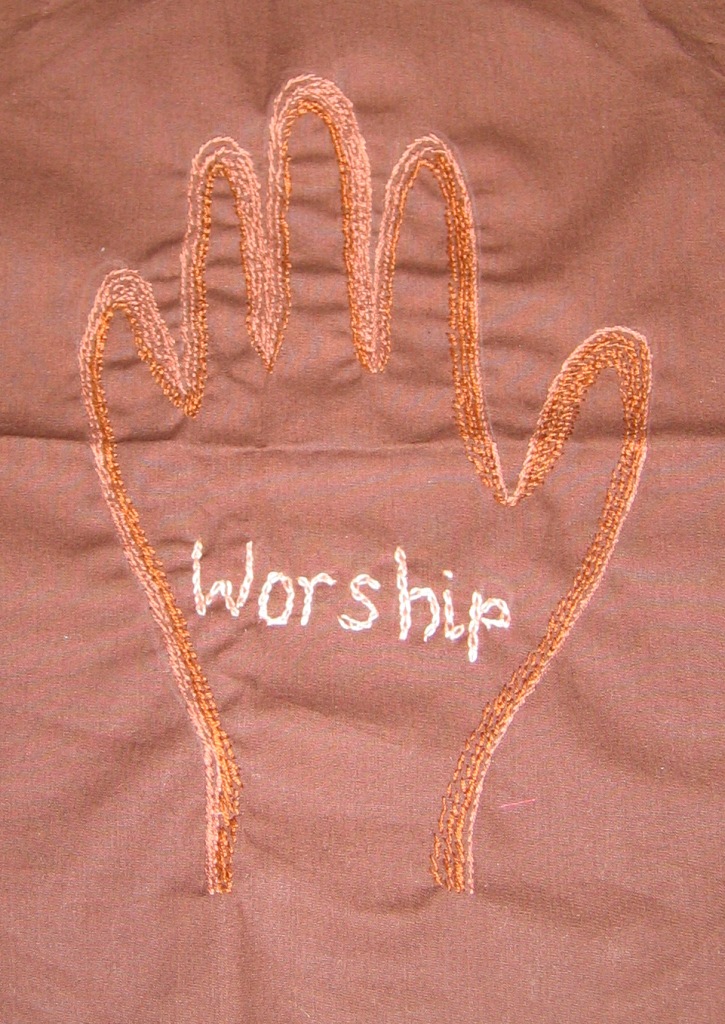
Most of us had used hand rather than machine embroidery to decorate our hands, and it was interesting to see the different approaches members of the group had taken. Some hands featured words, whereas others were more abstract. Here are some of the embroidered hands, both completed and in progress.


I had chosen some of the blue hand templates from the bottom of the layout to work with.


So far, I've only completed the embroidery on one.


The next meeting in on Friday 18 December. That is the date of the University carol concert, and the plan is that we attend the concert, and then meet afterwards. Bring any completed hands and Kath - who has been working tirelessly buying and cutting out backing fabric, and getting together details for the altar sets - will collect them in.

For anyone who can't make the December meeting, the next one is Friday 8 January, when we will start putting all the hands in position on the frontal!

Monday, 9 November 2015

Hats Amazing at Hat Works

On Saturday I went to one of the Open Blocking Days at Hat Works, where you get the opportunity to block hats on some of the vintage blocks in the museum's collection. It was great fun, and thanks to Bronwen Simpson for all her hard work organising it. Watch out for a full post just as soon as I finish my hat!

That's it for courses for 2015, but I can get my hatting fix by visiting the new exhibition at the museum; Hats Amazing.


Like most museums, Hat Works has a vast treasure trove of objects hidden away in storage. Now museums staff and partners have chosen their favorite objects from the collection, and Hats Amazing will bring to light artefacts which have not been exhibited before, and tell the stories behind them.

The exhibition has been put together by Heritage Lottery Fund trainee Hannah Josey. You can read her blog about her work and Hats Amazing here.