Showing posts with label vintage sewing machines. Show all posts

Sunday, 30 March 2025

Progress?

(In which I have another rant about Modern Life.)

I need to replace my phone. It has been glitching from time to time and apparently this is because, at all of three-and-a-bit years old, it cannot handle the latest technology used in various updates. I'm also going to have to do something about my Windows 10 laptop this year, although at least I've had that for eight years.

Not in need of an upgrade any time soon

As someone who makes most of her own clothes on a 92-year-old sewing machine which is still going strong and for which I can get spares, I am unimpressed, but not surprised, by all this. We live in a world where built-in obsolescence is king, and hang the consequences. I do appreciate that I am not comparing like for like - my sewing machine is purely mechanical and therefore far less complex than something which relies on software. But I still think that lessons could be learned from the way Singer attempted to keep older machines up to date, rather than just encourage/expect their owners to upgrade to a newer model.

The starting point seems to have been the idea that a Singer machine was an investment which was expected to last a long time, and to be passed down through generations (as happened with my mum's machine, which is now mine). So when electric machines became the norm, Singer devised a motor and light which could be attached to a hand crank or treadle model, using fixings which were already part of the machine.

The sewing machine as heirloom . . .

. . . and how to bring it up to date

Similarly, various attachments were designed which allowed a straight stitch machine to do fancier sewing by moving the fabric from side to side.

Attachments for my Singer machines

I already have a buttonhole attachment from, I think, the 1950s, but recently acquired an older version. It's in a cardboard box rather than a 'modern' plastic case, and uses wingnuts rather than plastic dials to make adjustments to width etc, but underneath the cosmetic improvements it's the same.

My older buttonholer

The attachments were made with the same longevity in mind as the machines, with anti-corrosion paper pasted into the box.

It clearly worked, as the buttonholer is rust-free

The 'zigzagger' is mechanically similar to the buttonholer, in terms of the way it moves the fabric. It comes with four different cams, which produce the various style of zigzag illustrated on the box lid.

Wonderful artwork

The zigzagger, with one of the cams inserted

The stitch design is on the cam

Singer also produced further sets of cams for the zigzagger and yes, I am keeping an eye out for them!

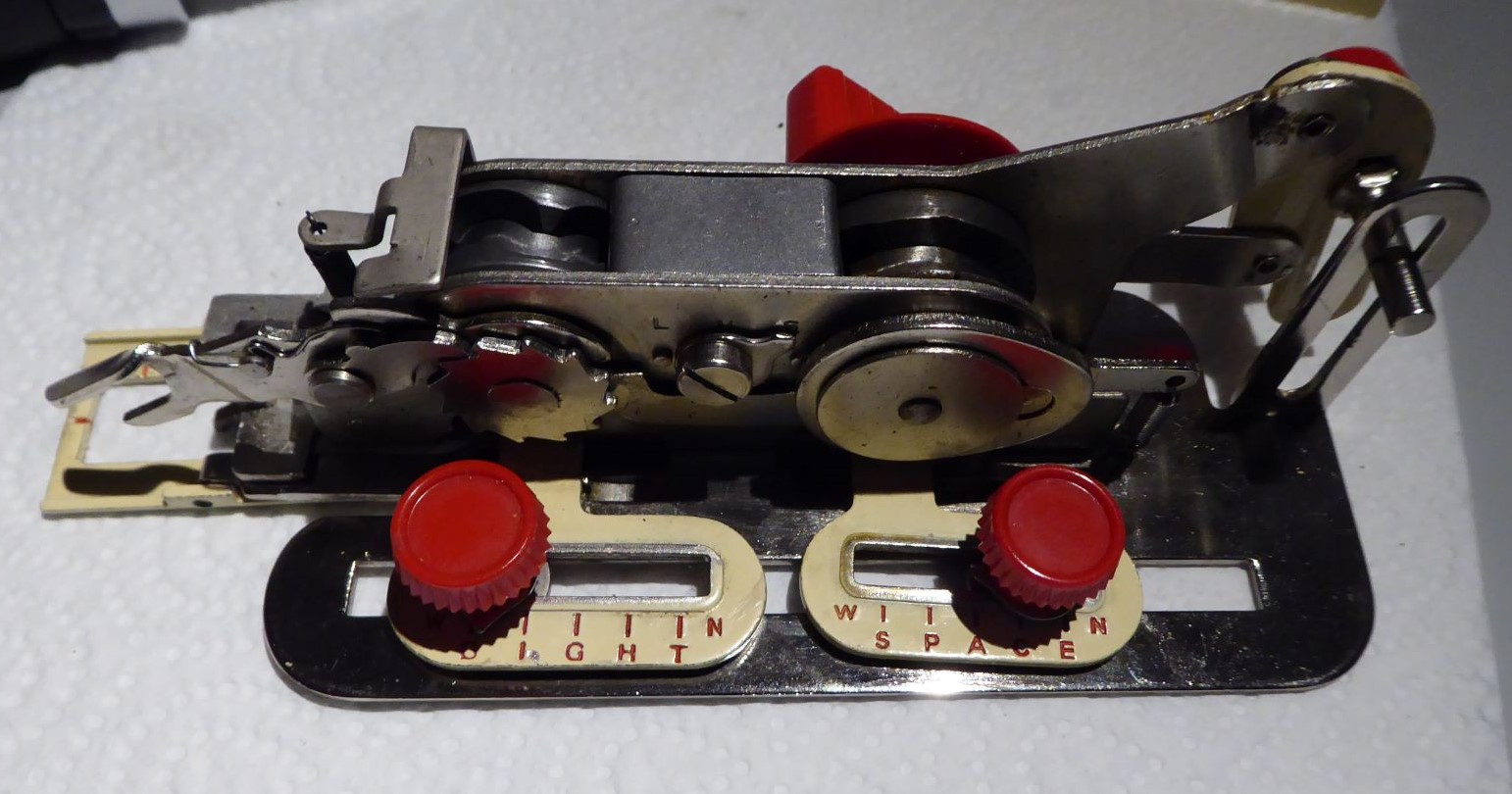
The final attachment which I have is the hemstitcher. It is by all accounts quite tricky to use.

Unlike the other two, it doesn't have a casing

It's also the only one of the three which still has its instruction leaflet, but all of these are available online.


The hemstitcher could also be used to produce a picot edging.

From the instructions

My mum can remember picot edging being offered as a service by the local Singer shop, for anyone who didn't want to try it themselves. The effect looked like this.

Picot edging on a frill

Seen from a modern economic perspective, Singer's determination to keep older machines usable rather than sell new ones seems bizarre. Presumably it came from a strong belief in the quality of their original product. Of course, ultimately none of this did Singer any good. They were slow to adapt to the changing market, and eventually folded. (The Singer of today is a different company from the original.) But I'm glad to have at least one piece of equipment in my life which I can expect to last for years to come.

Sunday, 30 June 2024

Poorly

Unfortunately, among the souvenirs I brought back from Edinburgh was a particularly bad cold/flu thing. There has been no sewing or knitting since I got home. On the first day, I felt too ill to even make a cup of tea. (To anyone who knows me IRL, this demonstrates just how bad things were!)

So for this week's post, some photographs of sewing machines in Edinburgh.

Starting with this wonderful carved sign on Candlemaker Row

There seemed to be a great many machines on display in various shop windows, but reflections made it hard to get decent pictures.

I'm a sucker for a pretty decal

Two more, plus bonus biscuit tin

Things were easier in the National Museum of Scotland. Seven machines of various makes are on display in the Window on the World, a four-storey high installation in the Grand Gallery.

Different ages, makes and stages of manufacture

Of course, the main connection between Scotland and sewing machines is Singer. Its Kilbowie factory was the largest in the world when it opened in 1885, and at its peak it produced more than one million machines a year. This connection is recognised in the museum's Science and Technology wing, with a display of three machines from different eras, a 12K from 1881, a 222K from 1958, and a 518 from 1978.

Top to bottom: 518, 222K, 12K

But the exhibit which thrilled my nerdy little heart the most wasn't actually a Singer. It was one of the first six of the 1846 type lock stitch sewing machines made by Elias Howe.

History!

While the basic principles of the stitch-forming mechanism haven't changed much since, how the fabric passes through the machine certainly has. Here, the seam to be sewn had to be pinned or held onto the large grey metal ring just visible at the bottom left (click here for a much better image), which rotated a little with each stitch. So of course, the operator had to stop frequently to pin more of the seam in place. Thank goodness for the invention of feed dogs and flat bed machines!

Sunday, 8 October 2023

Selling Singer, 1953

Not much sewing this week, so instead here is a new to me Singer sales brochure from May 1953.

"May I help you?"

Unlike earlier brochures, this one is in colour, and features the Singer Girl in her ever-so-slightly-migraine-inducing dress.

Excellent stripe matching

My eyes!

By this time the model 66 was no longer being made in Britain, so the choices were the 15k or 201k for a full-size machine, or the 99k for something smaller.

The machine options available

The larger machines could be fitted into a 'library table' or a more traditional cabinet, although I'm not sure if the latter was only suitable for treadle machines.

I'm guessing that this was the top of the range

Like my 1930s cabinet, this model has a "commodious" drawer which looks to be straining the meaning of the word!

Similar to my cabinet model, but with two doors

The 'contemporary' style table is the only one which has a version for the 99k. My guess is that this leaflet was given to its original owner in a Singer shop, as she has jotted down a few prices on these two pages. As with the 1930s sales, the cash price was lower than the price spread over 11 or 17 months. Mum's 99k with a carry case, bought cash price in April 1953, cost £30.8s.6d - which gives an idea of the price of the cabinet.

I think that the cash price of the 99k in this cabinet was £56.4s.6d

Even in 1953, clearly enough customers still wanted a plain treadle machine to make Singer include a double page spread of the options, although these were mostly the same base in different woods. The leaflet implies that the use of wooden legs rather than an iron stand is a recent development, even though they had been the available for at least 20 years!

Treadle options available (click to enlarge)

All three models are available on small wooden bases, although I would argue that describing a full size machine as "mobile" is pushing it a bit! Again, a non-electric option is available.

And 'portable' options

Definitely portable was the 221k, the 'Featherweight'.

The Featherweight is almost an afterthought in this leaflet

I love the quote that "a Singer is built to give years of trouble-free service". Whether Singer quite meant that to be the 70 years of my treadles, or the 100-plus years of Maud I’m not sure.

Mum remembers that the price of her machine included free lessons, and that the saleswoman was keen to ensure that she took them. A machine was a big investment, and personal recommendation was good (and free) advertising for Singer, so it made sense for them to ensure that their customers were happy with their purchase and could get the most out of it.

Why you should buy a Singer

Getting customers to understand and use all of the attachments which came as standard seems to have been an ongoing struggle, however.

Those funny metal bits in the cardboard box? Use them!

So that's what they do!

The 'typical' Singer shop on the back cover, with all its goods and services, looks marvellous.

Sewing heaven

I wonder which, if any, model the owner of this leaflet eventually bought?

Sunday, 15 January 2023

A January purchase

But not by me. This red plastic box was in a suitcase of vintage patterns and assorted sewing stuff which I bought at an auction ages ago (and it made a fair contribution to the overall weight of the suitcase).

Mystery box

I looked inside, thought "Ooh, interesting", and put it on a shelf in my workroom to investigate properly later. And there it has sat, for about 4 years, until it caught my eye during a recent tidy-up, and I decided that it really was time to look at it properly.

The detail on the box lid, below the Singer logo, gives a hint of what's inside.

Can you guess?

It's an attachment for making buttonholes on a straight-stitch machine, such as my 66s and 99s (but also models such as 15, 128, 185 and 201). The box is cleverly designed to hold all the pieces securely, so there's no danger of anything getting lost.

Everything neatly in place

This (important) piece actually screws into the box

Tucked right at the bottom of the box was the receipt. I assume that of the three items bought from the Singer shop in Chester, this was the one which cost four pounds, 18 shillings and fourpence. Sadly, although the receipt clearly shows the purchase date as 20 Jan, it does not give the year.

I wonder what else they bought?

There is no year mentioned anywhere in the instructions, either. There is however a reference to the "new "Featherweight" portable", so based on this I'm guessing at a date somewhere in the 1950s. This particular buttonhole attachment doesn't seem to have been sold in the States, so there's limited information about it online.

It's a complicated beast, as is apparent from the illustration and parts list (three pages long!) in the instruction manual.

All the parts

I love the fact that if a washer snapped or a spring broke, you could simply get a replacement part from Singer, rather than have to buy a whole new attachment. Mind you, that approach to sales may go some way to explaining why Singer eventually went bust!

With the cover removed

The attachment works by moving the fabric from side to side between stitches, so the machine's feed dogs have to be covered with the plate, which is screwed in place using the same holes as the seam allowance marker.

Feed cover plate in place

The attachment has a fork which is positioned around the needle clamp, and the whole thing is screwed onto the presser foot bar. It's a bit of a challenge to do all this without bending the needle!

Showing how the attachment is attached

Unlike later models, which used drop-in templates to make different styles such as keyhole, this version can only make straight buttonholes. It is possible to alter the density and width of the stitches and the width of the centre gap, however. The buttonhole length can be between ⅜" and 1", and it's possible to extend it up to 1⅞" with manual intervention.

I tried doing some test buttonholes, with red thread on top and cream in the bobbin. The initial attempts were not a success.

From 'very, very bad' to 'not much better'

The underside looked even worse.

This is the underside - there may be some tension issues!

At this point I took the buttonhole attachment off, checked the tension with ordinary straight stitching, and made a few adjustments until I was entirely happy with it. Then I tried again (this time with yellow bobbin thread).

The right side

The underside - at least it's mostly yellow

It's obvious that there's still a lot of work to be done, but I think that it's mostly in improving the skills of the operator! The instruction manual for Olive, my mum's (now my) 1953 Singer 99, has the threading diagram annotated with little felt tip arrows which I added because 50 years ago I couldn't follow the instructions - now I could probably thread a 99 or a 66 in my sleep. So the fact that I can't make perfect buttonholes on my first attempt isn't too much of a worry.

I should add that I did all this on Tilda, my original 66 treadle. I thought that treadling for long enough to do a buttonhole would be exhausting, but it took far less effort than I expected, even going round it twice. The instructions stress the need to work slowly, so a treadle rather than an electric machine is probably ideal.

I've written many times on this blog about hand sewing and slow sewing, and if I only have a few buttonholes to do on a garment then I think that hand-sewn buttonholes would remain my first choice. However, I have a couple of shirtwaist patterns on my 'would like to make' list, and even I balk at the idea of that many buttonholes. So there's a good chance that machine buttonholes may be making an appearance in my wardrobe sometime.

Lots of buttonholes - Hollywood 805, from 1942

Sunday, 11 December 2022

Emilie

Family issues have taken up a lot of what was meant to be my sewing time this week, to the extent that there's no chance of my completing my evening bag in time for the fancy dinner. I have a much simpler Plan B, but it's nowhere near advanced enough to make a blog post. So instead . . .

My latest acquisition

Vintage machine-wise, I've always been a Singer Girl, so with this I feel as though I've crossed over to the dark side! It all started ages ago, when I spotted this machine on an auction website.

It was all the fault of this picture

I had never seen blue and green decals before; most designs I've come across are gold, with occasional hints of reds, oranges or yellows. Courtesy of this webpage, I discovered that it was actually one of the many machines which Jones made under other names for various retailers, and that 'Kildare' was the brand name for Wm Whiteley Ltd in London.

Clearly, I am a sucker for a pretty decal - it's what first drew me to Deltic Elsie. So when I spotted a familiar image in the catalogue of my local auction house, of course I had to go to the viewing to take a look. I know almost nothing about shuttle machines but. . . everything moved, the shuttle was there (the one thing which I do know is crucial), the machine appeared to be in good condition, there were no dodgy electrics to consider and, well, one thing led to another!

The all-important shuttle

The case is different from either Singer bentwood cases or the more rectangular 'coffin tops'. The finish on both it and the machine base is in a poor state - when I peeled off the lot number sticker, the varnish underneath came away with it. I may end up sanding all the wood down and redoing it. On the plus side, the key is there, and the lock works.

Looking rather battered

The back of the machine is as ornate as the front.

More decals

I'm not sure how much it has been used. It is dusty/grubby on the outside, but there's no accumulation of fluff or grot inside. When I lifted the machine up, I found a pristine underside.

Well cleaned or barely oiled? I can't decide

I also found the instruction manual in the space under the machine. It appears to be dated September 1935, which fits in with the information I could find about the decals and serial number on this website.

'9/35' just visible at the bottom right

Looking though the instructions I discovered that Emilie (at some point, I will write a post about how my machines got their names) possesses a feature which none of my other vintage machines have, not even Mum's 1952 99K - reverse stitching!

Luxury!

She also still has all the feet which came as standard and, importantly, a couple of spare bobbins.

Feet for hemming, binding, braiding and quilting

There are also a couple of packets of needles, condition not yet checked. Pretty much the only thing which I know about vintage Jones machines is that they don't take what are now 'standard' needles i.e. 15x1. Instead, they take 128x1, which aren't readily available. Fortunately, I have discovered that Helen Howes sells them, and in a variety of sizes as well.

There isn't the wealth of information about the Jones CS that there is about Singer 66s and 99s, so cleaning and restoring Emilie is definitely going to be a voyage of discovery!