Showing posts with label 1930s. Show all posts

Sunday, 24 August 2025

Dressing to celebrate in 1937

Hospital visiting on Sundays takes rather longer than on other days as there are no buses, so I have to walk there from the station. The train service leaves me with ample time to do this before visiting begins, so today I used some of that time to pop in to Welsh Bridge Books & Collectables, which I had seen from the bus. It didn't have a large selection of craft or costume books, but I did get this.

Home Notes, May 1937

According to the article inside, "Of course you must celebrate the Great Day of May 12th with a new frock", and offers the pattern on the cover, plus the yarn for the accompanying scarf, for one shilling (12 old pence). Given that the magazine issue date is 1 May, and you would have to send off the order and then wait for the package to arrive before you could start either the dress or the scarf, this seems to me to be cutting it a bit fine timewise!

The instructions for both the dress and scarf are given in the magazine.

Dress instructions and cutting layout

Knitting instructions

Like most women's magazines of the time, Home Notes offered its own pattern service. Some of its other patterns appear in the colour centre spread, which features styles available in 40-50 inch bust sizes. Unlike the bracingly forthright Weldon's brand, Home Notes does not use the word "Outsize", or even "Matrons", sticking instead with, "The woman who isn’t particularly slender". Although of course the absurdly elongated 1930s figures still give an impression of slimness.

Patterns in larger sizes

The back cover is taken up with an advertisement for Home Notes' latest Fashion Book magazine.

Summer Fashions for 1937

As well as fiction, handy hints, and a variety of advertisements, the magazine also has an article on planning and making your Coronation summer wardrobe on a budget, but that deserves a post of its own.

Sunday, 2 March 2025

A 'Sweet' surprise at the Museum of Liverpool

I didn't expect an exhibition about a sweet factory to provide material for a blog post, but here we are!

When I was a student in Liverpool in the 1980s I lived near the Taveners confectionary factory on Beech Street, so of course I had to visit Sweet, the current exhibition about the company at the Museum of Liverpool. Like a lot of firms in the first half of the twentieth century, Taveners organised staff outings, and the display includes two photographs of such events in the 1930s. No doubt everyone wore their 'best' for these outings, but they are still a wonderful record of what working people, and especially young working women, wore at the time.

The first photograph was of the workforce in 1930, about to set off for the annual picnic in a fleet of charabancs.

Click on any image to enlarge it

A 'sharra' was a vehicle with rows of bench seats across it. There was a canvas cover which could be pulled up over the passengers if it rained - the covers are visible folded up at the back - but they were usually driven open-top if possible. The destination was probably Blackpool, which is about 45 miles from Liverpool. I imagine that the journey could get quite chilly, hence all the coats and (firmly pulled on) hats.

Hats and berets all round

One lady is taking no chances with the cold, and is wearing a fur stole.

Perhaps she just wanted to show off her fur

A couple of the men in the party are wearing open neck shirts, while others have stuck to wearing ties. Almost all of them have some kind of headwear.

I hope those large caps are well-secured!

The second photograph was taken four years later, in the Spanish Hall of the Blackpool Winter Gardens. The photo is a little blurred in places, but there's still a wealth of detail to look at.

Note the 'Spanish' decor

Even though it's indoors, some are still wearing their coats, including another fur.

Short sleeves and fur coats

A few women are wearing brimmed hats or berets, and there are even a few party hats.

A beret, and two brimmed hats

Mostly though it's a sea of bobbed, waved, hair.

Lots of Marcel waves

I wonder if these two planned to wear similar (possibly identical) jackets? The fact that they're sitting together suggests that they did.

Sisters? Twins?

Leaving aside the party hat, this pair look very stylishly dressed.

Is that some sort of button-on cape?

I would love to see a colour photograph of this print.

Oh to have some of that fabric!

The drapery of this dress obviously got a little crushed under a coat.

Tell-tale creases

Meanwhile these impressive sleeves, surely inspired by Letty Lynton dress, seem to have survived unscathed.

So many 1930s details

Although the workforce appears to be largely young girls, there are some older women there as well.

Similar hairstyles to the younger women

The top table appears to be mostly men, presumably in more senior positions. This seems to have been a more formal outing than the picnic (certainly it involved a sit-down meal), so ties are being worn.

Waistcoats, watch chains, and pocket handkerchiefs

Among the women standing behind them, the lady on the far left looks quintessentially 1930s. Sadly, that part of the photo is a little blurred, so I couldn't get a good close-up of her outfit.

Like a fashion illustration

The rest of the display was interesting, but unsurprisingly these two photographs were the highlight for me. It just goes to show that you never know where a bit of costume history is going to turn up. Sadly, the Beech Street factory closed last month as production was moved elsewhere. I hope that the Taveners archive is retained, ideally by the museum. Who knows what else it contains?

Sunday, 11 August 2024

The inevitable

It was always going to happen. Even as I typed the words last week, "Stash-neutral status is within reach", I knew that I was making myself a hostage to fortune. I just didn’t expect it to happen quite so soon!

Yes, I've bought some fabric.

"Snowdrop" cotton lawn by Peter Horton

I'm blaming American Duchess. I preordered a pair of their new Esme wedges in red and blue, and they arrived this week. They are stunning (you can read more about the design, and wedge shoes in general, here) and of course, I decided that they needed a suitable dress. I was in Liverpool this week, and thought that I would check out the John Lewis fabric 'department' while I was there. It's right on the top floor, tiny, and seems to get tinier every time I visit - it can only be a matter of time before it vanishes altogether. But despite this, it has an uncanny habit of containing just what I'm looking for.

Perfect match

It isn't a 1930s print, but this is a project where I'm not worried about historical accuracy; I was just delighted to find something in the ideal colours. Now I need to consider which pattern to use.

1930s (and one 1940) patterns

Two which came with magazines

Of course, the prospect of stash-neutral status has taken a hit, (as have my batch-cut projects, which was also fairly inevitable) but it was entirely worth it.

Back up to over six metres

Sunday, 4 February 2024

Travelling in Style

I went back to my old university this week, to visit the exhibition Travel in Style - Iconic Cunard Advertising in the 1920s and 1930s at the Victoria Gallery and Museum. The Cunard archive is held in the University of Liverpool library (Cunard and the White Star Line were both Liverpool firms, and merged in 1934), and this exhibition features a number of vintage posters, along with brochures, menu cards and other souvenirs of the time.

Detail of a Cunard poster

During this period cruising and leisure travel became an increasingly important part of the company's business.

Poster advertising travel on the Queen Mary

As well as posters, Cunard created advertising material such as brochures to sell this new type of travel to the public, using both photographs and drawings. Naturally, I was most interested in images which included clothing.

Dancing on board in the 1920s

In the drawing room in the 1930s

"A quiet half hour" (minus pianist?) on the Aquitania

The 'grande descente' in the 1930s

Articles in The Cunarder, the company magazine, stressed the importance of all images striking the right tone: for example menu cards for breakfast would look very different from those for dinner. This is definitely a dinner image.

Elegant dining in the 1920s

The crossing would take five to seven days (I can get queasy on the Mersey Ferry, so even thinking about being afloat for that long filled me with horror!), and there were plenty of ways to pass the time.

Sports day on the Carmania

As the owner of a tiny piece of Cunard memorabilia, I looked for any references to the Berengaria. There were a few, all from the 1920s when the ship was still one of the more modern in the fleet.

Illustration of the Berengaria

"the spectacular Berengaria"

Clearly the Berengaria had an indoor swimming pool

My favourite item in the exhibition, though, was this publicity shot of the Dorchester Glamour Girls (a dance troupe who performed at the Dorchester Hotel) on board the Queen Mary in 1938. The hats! The suits! The shoes!

I'll take one of each ensemble, please

Travel in Style - Iconic Cunard Advertising in the 1920s and 1930s runs until 16 March 2024.

Sunday, 17 September 2023

New (to me) patterns

All sorts of problems and distractions have prevented me from doing any sewing this week, so instead here's a short post about my latest vintage pattern acquisitions.

First up is this Style pattern.

Style 1451

I'm getting increasingly fond of late 1950s/early 1960s 'Style print' patterns, and am building up a bit of a collection - you can see some of them here. What attracted me to this one was the view A illustration. I have a remnant of blue and grey plaid in my stash which is quite similar, and it struck me that this might be a good use for it.

I have no current plans for this DuBarry pattern, I just liked it.

DuBarry 1658, 1937

According to A History of the Paper Pattern Industry, DuBarry patterns were sold exclusively in Woolworths stores and produced for Woolworths by Simplicity. The DuBarry patterns I own were all printed in Canada, and most have the UK price shown on a stick-on label. This is the first one I've come across with the price given in both U.S. cents and British old pence.

What can I say about my final pattern? I've posted many times in this blog about my love of the 1940s revival styles from the late 70s/early 80s, and nothing can shift my fondness for a (subtly) defined shoulder. But this, well this is something else.

Hollywood 1516

Despite what has been written on the envelope, both Blueprints of Fashion and the Commercial Pattern Archive date this pattern to 1945. The, ahem, remarkable shoulder feature is described in the pattern pieces as a "flange", and is set into the side-front seam at the front and the sleeve seam at the back.

Pattern pieces and back view

I don't think that Hollywood patterns (a budget offshoot of Vogue) were ever sold in the UK. Certainly this pattern, with its ornamental buttons, multiple seams, deep pleats, and associated hefty fabric usage, would have contravened the CC41 clothing regulations.

Yardages for bust sizes of 28" to 36"

Resizing it to fit me would be quite an undertaking, but I am tempted to try. Probably view three, though. It may be the red and black, but I'm getting distinct Flash Gordon vibes from those flanges - and that's not a look I need in my wardrobe!

Sunday, 6 November 2022

Invisible progress, and sleeve experiments

Even though I've had quite a lot of sewing time this week, anyone expecting photos showing a radically different dress is going to be very disappointed. Most of that time has been spent replacing tacked-on trim with properly sewn-on trim. It was only once I had completed the machine sewing that I remembered that the edges all had to be hand sewn down, as I did with the pockets. This was done from the wrong side, and took some time as I had to constantly check that the stitches weren't visible on the right side.

Once all the trim was on, I could finish sewing the back facing in place.

This just needs buttons and loops now

The next job was working out how to attach the 'trim' (actually 19mm / ¾" straight grain strips of the dress fabric, satin side out, with the raw edges pressed under) in a more-or-less horizontal manner round a darted sleeve head. I decided that the only way to do this would be to use a shaped piece instead.

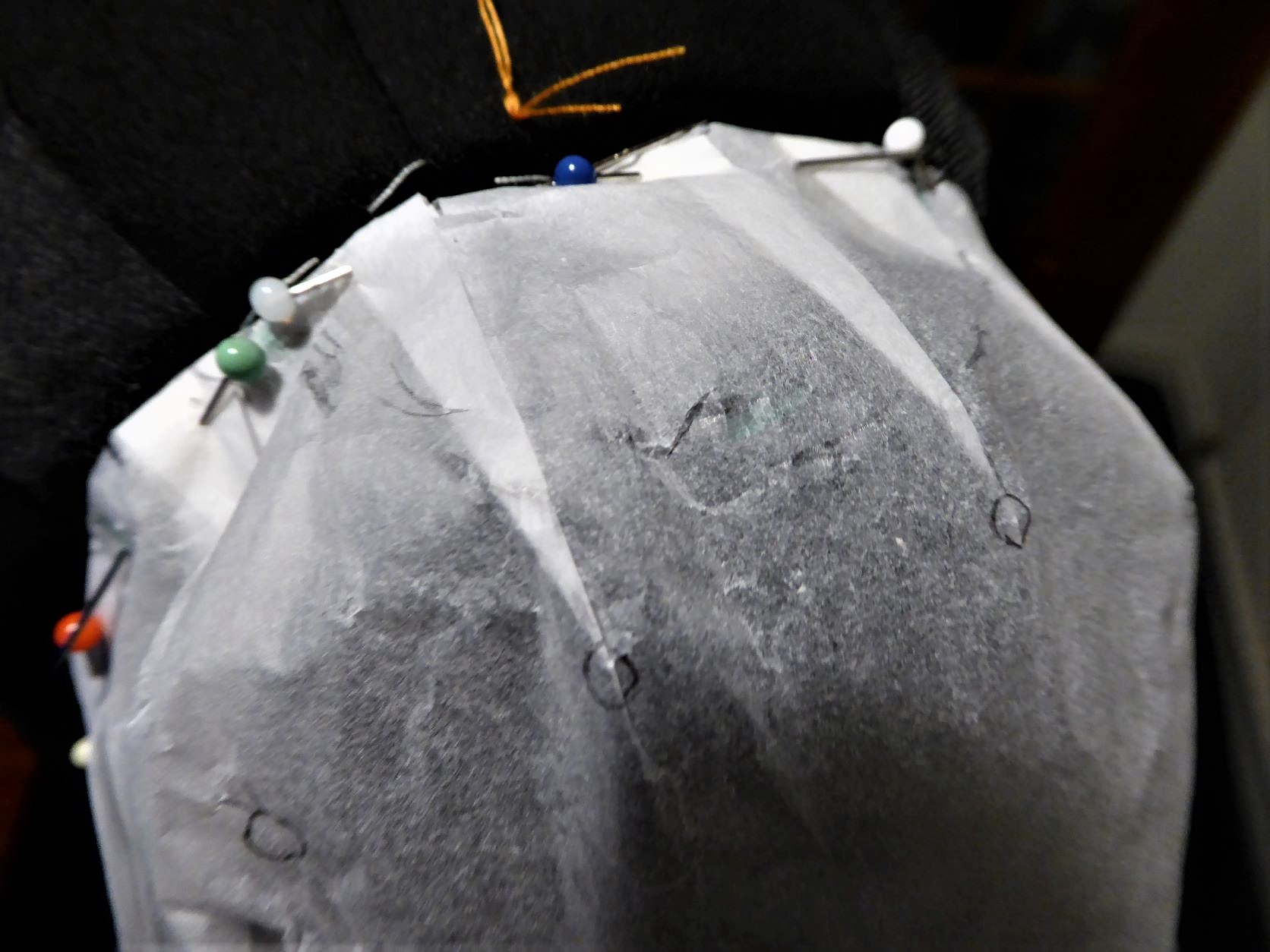
To work out the shape, I first cut a sleeve head out of tissue paper, taped the darts closed, and pinned it to the armscye.

Tissue sleeve in place

Then, I marked roughly where the top of the trim should be.

The marks are just visible

I removed my tissue sleeve, snipped open the darts, and laid it flat.

The darts created a slightly jagged line

I traced all this onto a second piece of tissue, so that I still had the original if I needed to make any changes. By this time the markings were getting quite busy, so I drew the darts in blue to identify them. I folded the darts on version two, smoothed out the upper curve, and added a second curve 19mm below.

It looks even more odd with both lines complete

Then I taped the darts closed, and cut along the curves.

I have a pattern!

I basted the sleeves back into the dress, and pinned the tissue pattern on. I think it works reasonably well. (Apologies for the very blurry image. I couldn't take a close-up in the mirror without blocking out the light, so I had to stand some distance away and enlarge the relevant part of the photo.)

Not bad

I had made some stiffeners to go inside the sleeve heads, just pointed ovals of silk organza folded in half and overlocked.

Sleeve stiffener

I’m not sure if I will actually need them, or if the applied 'trim' shape will fill out the sleeve enough on its own. Clearly more experimentation is needed. This is what slow sewing looks like!