Warning - picture-heavy post ahead!
I've been back in
Edinburgh for a few days. The main reason for the trip was to attend the wonderful
SewOver50 Frocktails event, but I also managed to catch up with old friends, finally meet some online friends in real life, visit the town where I grew up, and take a trip on the
Borders Railway down to Galashiels to see the
Great Tapestry of Scotland.
 |
| The Great Tapestry of Scotland - opening panel |
The 'tapestry' actually consists of 160 separate embroidered panels, worked mostly in wool on linen by groups of volunteers from designs by
Andrew Crummy. They are displayed in chronological order, covering the period from the creation of the land mass which would become Scotland to the end of the twentieth century - a mere 420 million years!
 |
| One of the seven 'zones' of the tapestry |
 |
| Panel 3 - The Formation of Scotland |
Each group received a linen panel with the design sketched onto it, a coloured drawing, yarn, small linen practice squares, and instructions.
 |
| An example of a panel 'kit' |
Having been involved with several group projects myself, I was very impressed with the way the project struck a balance between keeping enough consistency to create a harmonious overall look, but not being so rigid as to produce something uniform but lifeless. The addition of other materials such as lace, sequins etc was forbidden, but the group could decide what stitches to use. They also had licence to add small details of their own, relating to events which occurred during the construction of the panel. For example, the astronaut Neil Armstrong died while the Border Reivers panel was being stitched. As he was descended from a Borders family, a small moon was added to the top right corner of the panel.
 |
| Panel 45 - The Reivers and the Rescue of Kinmont Willie |
 |
| Panel 45 detail |
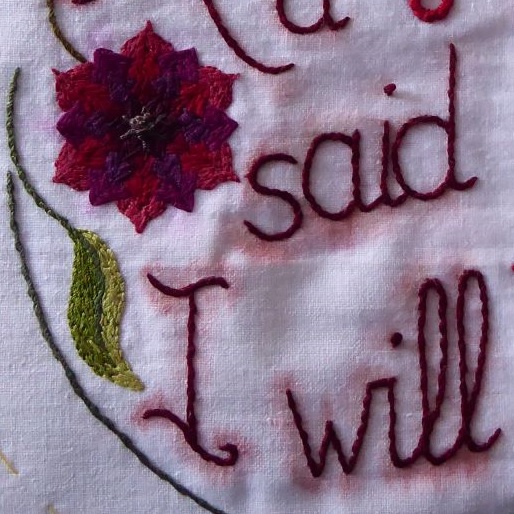
Some of the panels have a muted palette, and rely on stitch detail to provide the interest.
 |
| Panel 22 - The Flowers of the Borders |
 |
| Panel 22 detail |
Others are far more colourful.
 |
| Panel 27 - Haakon at Kyleakin |
The tapestry doesn't shy away from the darker elements of Scotland's history, such as the persecution of 'witches'. (I should add that you don't need to know Scottish history to enjoy the tapestry, each panel has a well-written 'story' beneath it, explaining the context. All of my school education took place in Scotland, but there was still a lot which was new to me.)
 |
| Panel 49 - Witches |
There are more humorous panels as well, such as the battle of Sheriffmuir in the 1715 rising - a confusing and indecisive encounter in which both sides were simultaneously attacking and fleeing!
 |
| Panel 58 - The Jacobite Rising of 1715 |
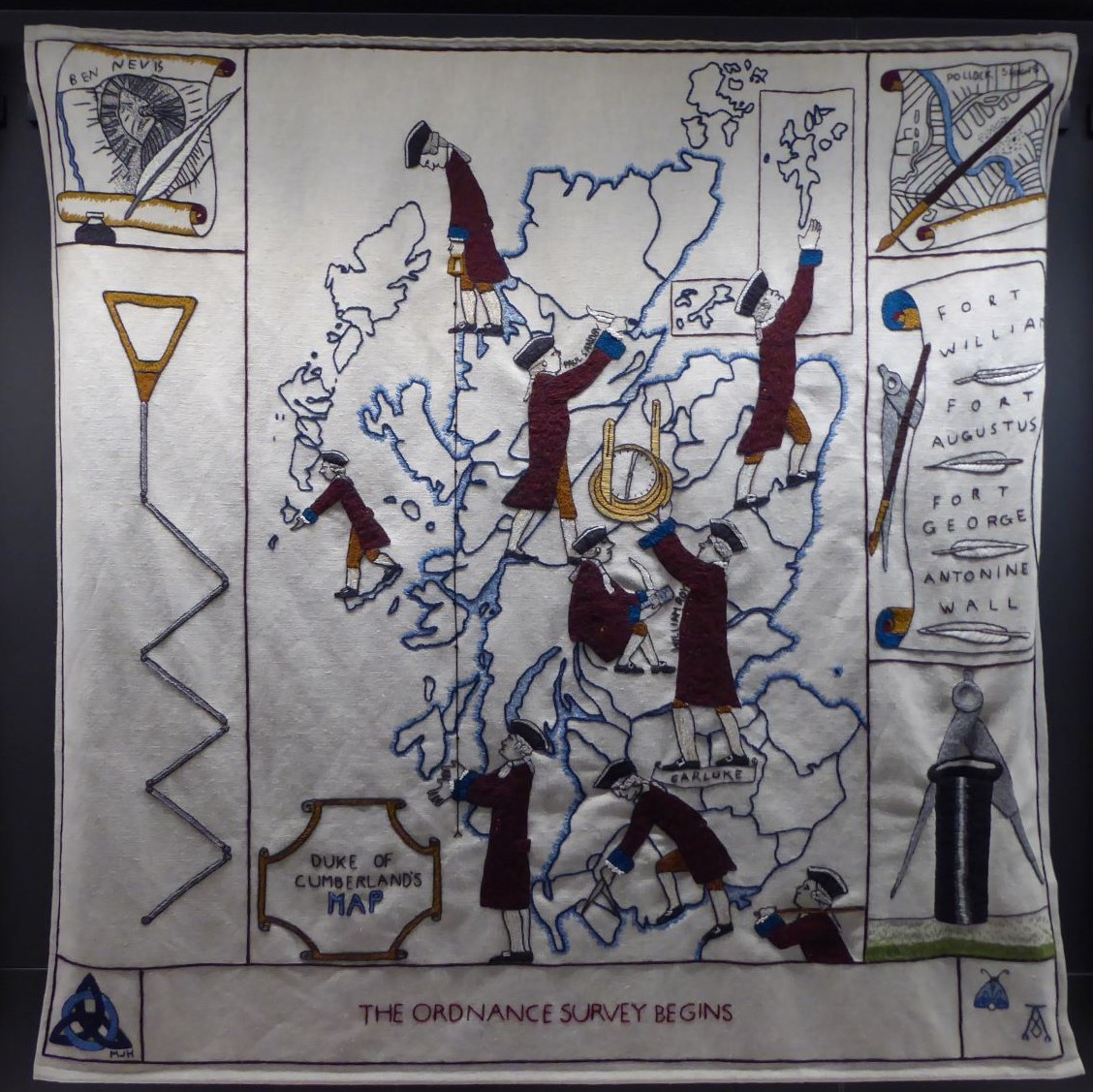
As a geographer, I particularly liked this panel.
 |
| Panel 61 - The Ordnance Survey |
Some of the detail is astonishingly well rendered, such as the warp threads and the woven cloth in this panel.
 |
| Panel 73 - Weaving and Spinning |
 |
| Panel 73 detail |
In fact, I found that it was easy to get too absorbed in the details. Sometimes I had to make a conscious effort to step back and take in the sweeping lines and clever effects of the overall design.
 |
| Panel 95 - The Railway Boom |
But back to the details. Tucked down the side of the Clydebank blitz panel was one which was particularly relevant to me - the Singer factory clock tower.
 |
| Panel 132 - The Clydebank Blitz |
 |
| Panel 132 detail |
At the start of the exhibition there is a small display of 'things to look out for'. It includes a section on "Beasties" (animals), and there are lots of them, including a
Jacobite-supporting mole and a
Polish soldier bear!
 |
| Panel 60 detail |
 |
| Panel 133 detail |
The 'history' element of the tapestry ends with the opening of the Scottish parliament in 1999.
 |
| Panel 155 - The Scottish Parliament Reconvenes, 1999 |
The final two panels are a double one, mirroring the double panel at the start, and a tree listing the project's supporters.
 |
| Panel 159 - The Surge of the Sea |
 |
| Panel 160 - The Credit Tree |
I could very happily go back for another visit, as there is just so much to see in the tapestry. The entry ticket lasts all day, so it's possible to nip out for a cup of tea and a break, as I did, but even with that I'm sure there’s a lot that I missed.
The Great Tapestry of Scotland is open seven days a week and is in the centre of Galashiels. It's very easy to find, just follow the thread along the pavement!
 |
| Follow the blue yarn road |